
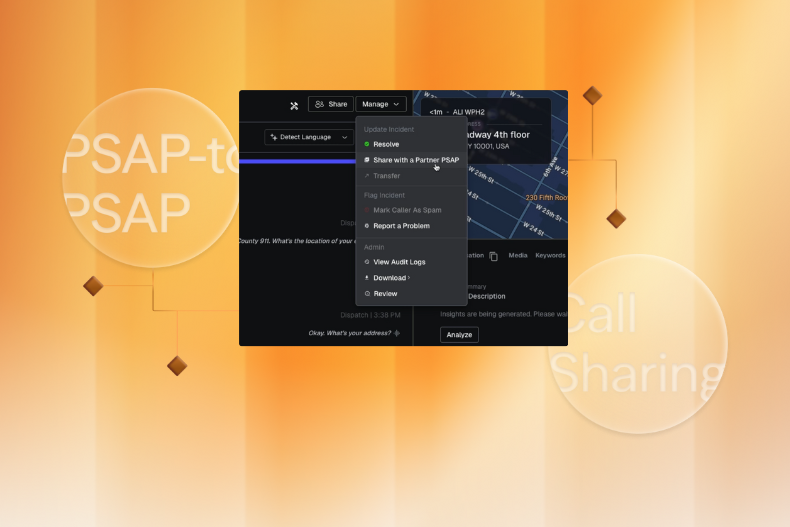
Whether for outages, overflow, or simply crossing jurisdictional boundaries, PSAP-to-PSAP call routing is one of the most fragile parts of emergency communications. The systems supporting those transfers were never designed to preserve shared understanding across agencies.
The result is not just inefficiency, but hidden risk. Dispatch is delayed, callers are forced to repeat critical details, and records fragment across agencies.
Drawing on real-world experience from PSAP leaders, lessons from large-scale disasters like Hurricane Helene, and discussion during our PSAP-to-PSAP Interoperability Webinar, this article explains why 911 calls move between PSAPs, what breaks when agencies operate independently, and what reliable PSAP-to-PSAP call sharing looks like in practice.
What Conditions Cause 911 Calls to Move Between PSAPs
PSAP Outages and Infrastructure Failures
Fiber cuts, power outages, cyber incidents, and severe weather can render a PSAP unable to take calls. During Hurricane Helene, dozens of North Carolina PSAPs lost operational capacity at the same time, forcing calls to be rerouted across the state.
Mike Reitz, Director of Chatham County Emergency Operations, described the reality on the ground during Helene:
“Hurricane Helene was an absolutely devastating event for western North Carolina. We were able to process calls, but we were four hours by car away from that PSAP. So we’re taking real-world emergencies, and the challenge became: how do we get it back to that originating PSAP for dispatch?”
The ESInet successfully rerouted calls for answering, but dispatch coordination depended on improvised tools, radio traffic, and manual workarounds.
Large-scale outages are not theoretical risks. They are recurring events that force calls to be rerouted with little warning and limited coordination. Recent incidents, including a major Pennsylvania 911 outage, show how quickly call handling and dispatch can become disconnected when centers operate independently.
High Call Volume and Overflow Situations
During storms, major accidents, or regional emergencies, PSAPs may overflow calls to neighboring centers to maintain answer times.
While this protects access to 911, it introduces new risks. Overflow centers may not know local geography, available resources, or dispatch protocols.
Calls are answered, but actionable understanding lags behind.
Cross-Jurisdiction and Boundary-Related Incidents
Calls near jurisdictional boundaries, or incidents involving state police, EMS, or highway patrol, often require PSAP-to-PSAP transfers even when infrastructure is functioning normally.
These scenarios are frequent, predictable, and unavoidable. The quality of the handoff determines whether response is delayed or seamless.
What Breaks and What Gets Lost When PSAPs Operate Independently
When calls move but agencies remain operationally isolated, failures tend to cluster in two areas: information integrity and visibility. These failures rarely appear as a single catastrophic error. Instead, they compound quietly across transfers.
Context Loss Before the Call Ever Reaches CAD
Traditional interoperability tools, especially CAD-to-CAD, focus on records created after a call is processed, losing everything that happened beforehand.
Jeremy Schwartzman, Operations Supervisor at Cary Emergency Communications Center, described this gap clearly:
“What CAD-to-CAD doesn’t capture necessarily is what happens before it enters CAD. You’re taking [calls] on faith a lot, and you’re also making a lot of inferences.”
Critical details such as evolving caller statements, uncertainty, and nuance often never make it into downstream systems. This is why modern assistive call-taking tools matter. These tools capture live transcripts, summaries, and context while the call is still unfolding.
Repeated Caller Questioning Under Stress
Without shared context, receiving PSAPs must re-verify information that has already been gathered. Callers are forced to repeat details during moments of extreme stress.
Repeated questioning delays dispatch and increases caller distress, particularly during medical emergencies, active incidents, or disasters.
Fragmented Timelines and Conflicting Records
Each PSAP documents only its portion of an incident. Verbal summaries, radio traffic, delayed callbacks, and manual notes introduce inconsistencies that are difficult to reconcile later.
No agency sees the full lifecycle of the call once it crosses boundaries, limiting learning, review, and prevention.
Loss of Visibility Into Related or Prior Incidents
When agencies operate independently, they also lose visibility into related or prior incidents that could meaningfully change how a call is handled. Caller history and nearby incident context are rarely shared across PSAPs, even when calls originate from the same person or location.
The stakes, says Neal Soni, Prepared’s Head of Product, couldn’t be higher: “Caller histories are an example of something that can actually save people’s lives.”
Limited Visibility Into Ownership and Action
When calls are transferred manually, it is often unclear who has acknowledged responsibility, whether dispatch has occurred, or what decisions were made.
During Hurricane Helene, these visibility gaps forced PSAPs to improvise.
“We ended up using a Google Sheet at one point just to start tracking calls,” Reitz said.
Problems were not prevented. They were rediscovered under pressure, without a shared record of ownership, decisions, or actions that could have reduced confusion in the moment or improved preparedness the next time.
What Reliable PSAP-to-PSAP Call Routing Looks Like
Continuity During Outages and Surges
Reliable PSAP-to-PSAP call sharing allows calls to be processed in one center while dispatched in another, at the same time.
With shared context, dispatchers can act immediately using their own dispatch workflows and systems while the call is still in progress.
As Reitz explained:
“If we had this set up where automatically those calls are auto-shared, they can dispatch it faster. Much, much faster.”
Preserved Context Across PSAP Boundaries
Audio alone is not enough. Reliable call sharing preserves transcripts, summaries, location data, timestamps, and media so the caller’s story moves intact from first contact through response.
This ensures that receiving PSAPs do not rely on assumptions or secondhand summaries.
Clear Acknowledgement of Responsibility
Reliable systems allow receiving PSAPs to explicitly acknowledge ownership of a call. This replaces assumption with confirmation and eliminates uncertainty about who is dispatching and when.
Shared Visibility Without Forcing Central Control
Each PSAP continues to use its own CAD, policies, and local expertise while sharing the information needed to act quickly and confidently.
As Reitz summarized:
“This is, in my opinion, a replacement to the traditional CAD-to-CAD, because we’re sharing the call processing data before it hits the CAD.”
Conclusion: Interoperability Is About Shared Understanding, Not Just Shared Calls
NG911 modernized how 911 calls move. The next evolution modernizes how information moves with them. When PSAPs can see the same call at the same time with the same context, transfers stop being friction points and start becoming seamless collaboration.
This approach has already proven life-saving in day-to-day operations, including incidents where rapid access to shared context directly enabled faster response and rescue.
Schwartzman concludes, “The direction that this product and others are going in is absolutely the future of this kind of work.”
For PSAP leaders planning for outages, overflow, and cross-jurisdiction incidents, the takeaway is clear: reliable interoperability starts before dispatch, and it depends on preserving context, not just routing calls.


.svg)